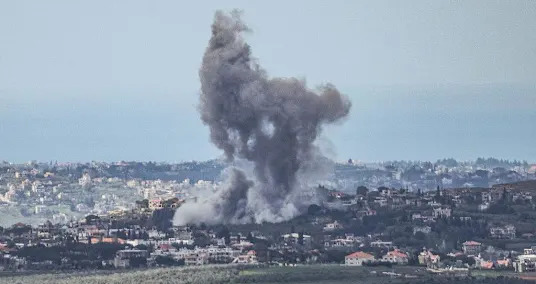
Israel's defence minister has said a buffer zone will be set up inside southern Lebanon and that Israel will keep security control over a swathe of the territory even after the end of the current war against the armed group Hezbollah.
Israel Katz said the area to be occupied would go up to the Litani River in southern Lebanon - about 30km (18.6 miles) from the border with Israel.
He also said all houses in Lebanese villages near the Israeli border would be demolished.
Israel sent ground troops into southern Lebanon on 2 March and has also been launching broad strikes across the country.
The action was taken after Hezbollah fired rockets into northern Israel in retaliation for Israel's assassination of Iran's supreme leader in late February, at the start of the war with Iran.
Israel was also carrying out near-daily strikes on Hezbollah before that despite a ceasefire that was agreed in 2024.
Since early March, at least 1,238 people have been killed in Lebanon, according to the Lebanese health ministry, including at least 124 children. The UN's humanitarian affairs office says 52 health workers have also been killed.
In the same period, 10 Israeli soldiers and two Israeli civilians have been killed by Hezbollah attacks, Israeli authorities say.
Others killed in the south in recent days include three Indonesian peacekeepers, and three Lebanese journalists, according to the UN and the Lebanese health ministry.
The Israel Defense Forces (IDF) confirmed it killed two of the journalists, describing them as "terrorists" without providing evidence to back up its claims. It also said it was aware of reports a female journalist was killed.
It has not yet been established who killed the peacekeepers.
More than a million people - roughly one in every six in the country - have also been displaced, worsening an existing humanitarian crisis in Lebanon.
Israeli officials say the aim is to protect communities in northern Israel from Hezbollah attacks.
Speaking in a video statement published by the defence ministry on Tuesday, Katz gave further details on Israel's military intentions in southern Lebanon.
"At the end of the operation, the IDF will establish itself in a security zone inside Lebanon, on a defensive line against anti-tank missiles, and will maintain security control over the entire area up to the Litani."
"In addition, the return of more than 600,000 residents of southern Lebanon who evacuated northward will be completely prohibited south of the Litani until the safety and security of northern residents are ensured," he added.
"All houses in villages near the border in Lebanon will be destroyed - according to the model of Rafah and Beit Hanoun in Gaza - to remove, once and for all, the threats near the border to northern residents," he said.
Katz had already announced the intention to create a buffer zone in the south of Lebanon earlier in the month. He had also already said displaced residents would not be allowed back until northern Israel was safe and that houses would be demolished.
But his latest statement goes a step further than his last, as he said Israeli troops would stay in the region after Israel's war with Hezbollah ends.
Southern Lebanon is the heartland of Lebanon's Shia Muslim community, Hezbollah's main support base. But it is also home to other communities, including Christians.
The latest Israeli ground invasion has already caused widespread alarm among the Lebanese.
Under the ceasefire agreement that ended the war in 2024, Hezbollah was meant to disarm and leave its positions in the south. This was to be supervised by the Lebanese government and army.
Progress was made, but it was partial. Israel also maintained several military posts in the south and continued to carry out regular attacks on what it said were Hezbollah targets.
The will may have been there for the Lebanese government to disarm Hezbollah, but it has always lacked the ability to do so. The prospect of a major confrontation between the Lebanese state and Hezbollah has also long been a major concern, reawakening fears of a descent back into civil war.
Katz previously said that Israel was taking action because the Lebanese government had done "nothing".
Lebanon's President Joseph Aoun has described the Israeli plans as a "collective punishment against civilians", and that they could be part of "suspicious schemes" to pursue an expansion of Israel's presence in Lebanese territory.
LATEST POSTS
- 1
 There are thousands of aligned holes in Peru. Archaeologists now think they know who made them
 - 2She just became the first wheelchair user to travel to space
- 3Cocoa Prices Settle Lower on Expectations of Adequate Supplies
- 4They died 'doing what they loved': The stories of workers in their 80s who died on the job
- 5Soldiers seize power in Guinea-Bissau and detain the president


- The Universe of Impeccable Pearls: A Manual for Valuable Gems
- Chinese astronauts’ return to Earth delayed over fears spaceship damaged by debris
- Phenomenal Web-based MBA Stages for Proficient Headway
- I asked ChatGPT who would win a Golden Globes. Here's what it got right — and totally wrong.
- Abbott issues US device correction for some glucose monitors over faulty readings risk
- Vote in favor of your #1 Sort of Convenience for a Family
- Ageless Tastefulness: An Outline of Valuable Gemstones and Adornments
- The Incomparable Advanced cameras: Which One Will Win?
- A Past filled with Old Civilizations: The World's Most established Societies


