By Joey Roulette
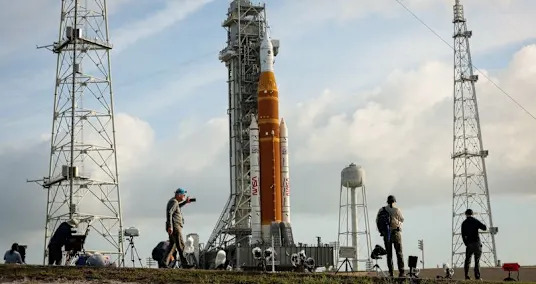
CAPE CANAVERAL, Florida, April 1 (Reuters) - NASA is set to launch four astronauts as soon as Wednesday evening on a 10-day flight around the moon, marking the most ambitious U.S. space mission in decades and a major step toward returning humans to the lunar surface before China's first crewed landing.
NASA mission managers on Monday polled "go" to launch the Artemis II mission's towering, 322-ft (98-m) Space Launch System (SLS) rocket topped with the astronauts' Orion crew capsule as early as 6:24 p.m. EDT (2224 GMT) on Wednesday.
It will launch from NASA's Kennedy Space Center in Florida just one pad away from where the last moon-bound astronauts of the U.S. Apollo program lifted off more than half a century ago.
The Artemis II crew includes NASA astronauts Christina Koch, Victor Glover and Reid Wiseman and Canadian astronaut Jeremy Hansen, who landed in Florida from Houston on Friday.
They had been in a two-week quarantine leading up to liftoff and spent time with their families over the weekend at the Kennedy Space Center's beach house, a spot where astronauts rest before blasting off into space.
"Certainly all indications are right now, we are in excellent, excellent shape as we get into count," launch director Charlie Blackwell-Thompson told reporters on Monday.
Weather conditions appeared favorable for an on-time liftoff, with only a 20% chance of souring within the agency's two-hour launch window on Wednesday. If the weather worsens and triggers a scrub, NASA could try again to launch any day until April 6, after which it would wait until April 30 for its next opportunity.
The launch had originally been planned for as early as February 6, and then March 6, until a pesky hydrogen leak prompted NASA to roll the rocket back to its vehicle assembly building for scrutiny.
FARTHEST TRIP IN HISTORY
The Artemis II mission will send the crew on a winding, nearly 10-day journey around the moon and back, sending them some 252,000 miles (406,000 km) into space - the farthest humans have ever traveled.
The current record for the farthest spaceflight at roughly 248,000 miles is held by the three-man crew of the Apollo 13 lunar mission in 1970, which was beset by technical problems after an oxygen tank exploded and was unable to land on the moon as planned.
Humans have not left Earth's orbit since the final Apollo mission in 1972.
NASA launched its first Artemis mission without crew in 2022, sending the gumdrop-shaped Orion spacecraft on a similar path around the moon and back.
Artemis II will pose a greater test of Orion and the SLS rocket. The astronauts on board will test critical life-support systems, crew interfaces and communications. They will also take manual control of Orion in space roughly three hours after launch to test its steering and maneuverability, a key feature should its automated systems fail.
Lockheed Martin builds Orion, while Boeing and Northrop Grumman have led the development of SLS since 2010, a program partly known for its ballooning costs at an estimated $2 billion to $4 billion per launch.
Elon Musk's SpaceX and Jeff Bezos' Blue Origin are racing to develop lunar landers that NASA will use to put its astronauts on the lunar surface.
The Artemis II mission is a key early step in the agency's multibillion-dollar Artemis program that envisions a long-term settlement on the lunar south pole. NASA is pressing hard to land its first crew of astronauts there on the Artemis IV mission by 2028, before China does around 2030.
Artemis III had been set to be the agency's first astronaut moon landing, but new NASA Administrator Jared Isaacman in February added an extra test mission before the landing.
(Reporting by Joey Roulette; Editing by Jamie Freed)
LATEST POSTS
- 1
 Vote in favor of your #1 Kind of Cap
 - 2Finding Europe's Head Traveler Objections: An Excursion Through Famous Attractions
- 3Careful Living: Embracing the Current Second
- 4Flu cases are rising with a strain that makes older people sicker
- 5NAFFIC and Aware to Launch First China-Europe Digital Product Passport



- What to know about Jack Dorsey's new Vine revival, DiVine
- Agios Pharma shares jump as US FDA expands approval for its blood disorder drug
- Europe's powerful Ariane 6 rocket launches Sentinel-1D Earth-observation satellite to orbit (video)
- New Year's superstitions: Eating 12 grapes, avoiding laundry and other rituals that are said to bring good fortune
- 'The best gift ever': Baby is born after the rarest of pregnancies, defying all odds
- Clocks to go forward one hour in Europe as summer time starts
- 5 Fundamental Ways to employ a Criminal Legal counselor
- This Tiny Neon Frog Dwells in the Clouds
- Nature: 10 High priority Setting up camp Spots In Europe