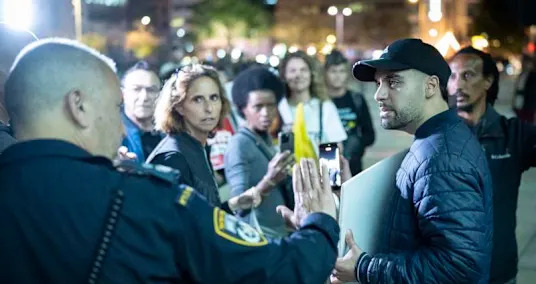
Protests took place in Tel Aviv, Jerusalem, Haifa, and Beersheba, as a survey found broad but uneven support among Jewish Israelis for Operation Roaring Lion.
Israel Police arrested 21 anti-war protesters Saturday night as demonstrations against the conflict with Iran expanded in multiple cities despite restrictions on public gatherings.
Protests took place in Tel Aviv, Jerusalem, Haifa, and Beersheba, with hundreds of participants reported in Tel Aviv and Jerusalem and about 100 in Haifa, marking the largest turnout since weekly demonstrations began. Authorities said 13 people were arrested in Tel Aviv and eight in Haifa.
Police said the gatherings were not approved under Home Front Command regulations that ban events with more than 50 people. Officials said the increase in turnout followed calls by groups opposing the government to protest despite the restrictions.
“During a situation assessment that took place at the scene with a Home Front Command representative… it was clarified that there was a real risk to human life and accordingly, Yarkon [precinct] police commander Tzachi Sharabi ordered the gathering to be dispersed,” police said.
Hadash-Ta’al chairman Ayman Odeh, an Arab lawmaker involved in the protests, criticized the police response, calling officers fascists “in the service of the government” and saying they were afraid of “the heroic citizens who went out, despite everything, to make their voice heard.”

Survey shows broad, uneven support for war
The demonstrations come as a March 2026 survey by the Israel Democracy Institute found broad but uneven support among Jewish Israelis for Operation Roaring Lion. Support was strongest on the Right at 87% and about half on the Left.
The survey also found that Jewish and Arab respondents largely agreed that Iran’s resilience has been stronger than expected. Most Jewish respondents said Israeli society could sustain the campaign for up to one month, while 28% said as long as needed. Arab respondents were less optimistic about how long the public could endure the conflict.
A majority of Jewish respondents said Prime Minister Benjamin Netanyahu’s decision was driven by security considerations, while most Arab respondents viewed it as political.
LATEST POSTS
- 1
 Setbacks in Texas and elsewhere put Republicans' redistricting hopes in doubt as key deadlines loom
 - 2Investigating the Advantages of a Bank account: A Complete Aide
- 3Exploring Programming Greatness: A Survey of \Easy to use Connection points\
- 45 Christmas movies to stream for less with this Paramount+ Black Friday deal
- 5Scientists find new clues to why female fertility declines with age


- Figure out How to Introduce Sunlight powered chargers on Your Rooftop securely
- Home Wellness Basics: Building Your Home Exercise center
- Massachusetts court hears arguments in lawsuit alleging Meta designed apps to be addictive to kids
- Everything you should know before booking a trip to Spain
- Noctourism: the new safari travel trend that's changing the wildlife we can photograph in Africa
- Eleven Creations And Developments That Steered History
- IDF kills senior PIJ Gaza City Brigade cmdr. who infiltrated Kibbutz Nahal Oz on Oct. 7
- Zelensky sees win for Ukraine as EU finally reaches funding deal
- Vote In favor of Your Number one Kind Of Food Conveyance Administration